Orthodox Christian dating in Texas
Orthodox dating in Texas: the parishes of Houston, Dallas, Austin and Galveston, and how to look for a spouse inside the Church. Free, no subscription.
Create your profileAn illustration, not a data map.
- Greek
- Antiochian
- ROCOR
- Serbian
- OCA
- Monastery


Short answer
If you are Orthodox and single in Texas, the Church is here and has been for a long time: the first Orthodox parish in the state was organized in Galveston in 1895, the Greek parishes go back to 1910, and today five jurisdictions keep cathedrals, parishes and two monasteries between the Gulf and the Hill Country. What you may be short of is a way to meet someone who takes the same faith seriously, in a state where the next parish can be a three-hour drive down an interstate. This page is about where Orthodox life in Texas actually happens and how to look for a spouse inside it.
What this page leads to is cana.love, a free dating site for people who want marriage. Its questionnaire asks which church you attend and how often, what you do about fasting, and which of twelve Orthodox jurisdictions is yours, so a Greek from Houston and a convert from St Seraphim in Dallas can find each other by what they actually do, not by a box marked "Christian".
Not an Orthodox-only site, and the section on what cana.love is and is not says who else is here.
Orthodox Christians in Texas
Orthodoxy came to Texas through the port. In Galveston, Serbs, Greeks and Russians organized a parish together in 1895 with the personal support of Tsar Nicholas II, who declared "Let there be an Orthodox Church in Galveston" and sent the icons and the Gospel book that are still in the church on Avenue L. The parish describes itself as multi-ethnic from its inception, and its first priest, Archimandrite Theoclitos, is buried beneath the altar. The Greek parishes followed inland: in 1910, by the Fort Worth parish's own account, there was not a single Orthodox parish between Los Angeles and New Orleans, and by November of that year St Demetrios had been chartered in Fort Worth, where the stockyards had drawn Greek immigrants; Houston bought a lot for its church in 1917, and San Antonio founded its parish in 1924.
Since then the largest change has been the converts: adults who came to the faith with no Orthodox family behind them. It has been counted: in twenty parishes of six jurisdictions in fifteen states, the Orthodox Studies Institute found that two out of three converts received since 2013 were under forty, that the largest single age group was the thirties, and that 44 percent arrived unmarried.
Orthodox Studies Institute, 2024; national figures, not Texan
Texas was not counted separately, but the person in those figures is the one at coffee hour in Austin or Dallas: an adult who chose the faith, often out of a Protestant upbringing, and still single. The OCA cathedral in Dallas says plainly that all its services are in English, and Texas A&M has what the Orthodox Christian Fellowship calls the Church's first campus missionary location and one of the largest OCF chapters in the country.
Five jurisdictions shape the state. The Greek Orthodox Metropolis of Denver covers Texas and has its cathedral in Houston, on Yoakum Boulevard. The Orthodox Church in America's Diocese of the South keeps its chancery in Dallas, with St Seraphim Cathedral on Wycliff Avenue as its seat and, in the OCA's own directory, close to twenty parishes and missions across the state plus a monastery. The Antiochian Archdiocese has parishes in Houston, Spring, Austin and Beaumont. The Russian Church Abroad's Diocese of Chicago and Mid-America runs a Louisiana–Texas deanery with parishes from Houston to Lubbock. The Serbian Diocese of New Gracanica and Midwestern America holds Galveston, Irving, Leander, Bulverde and Cypress. Other jurisdictions have parishes here as well; the directory of the Assembly of Canonical Orthodox Bishops lists them all.
Where the community gathers
Texas is a triangle of three Orthodox worlds, Houston, Dallas–Fort Worth and Austin–San Antonio, joined by Interstates 45, 10 and 35, with a fourth world scattered across the west and the Valley.
Houston and the Gulf
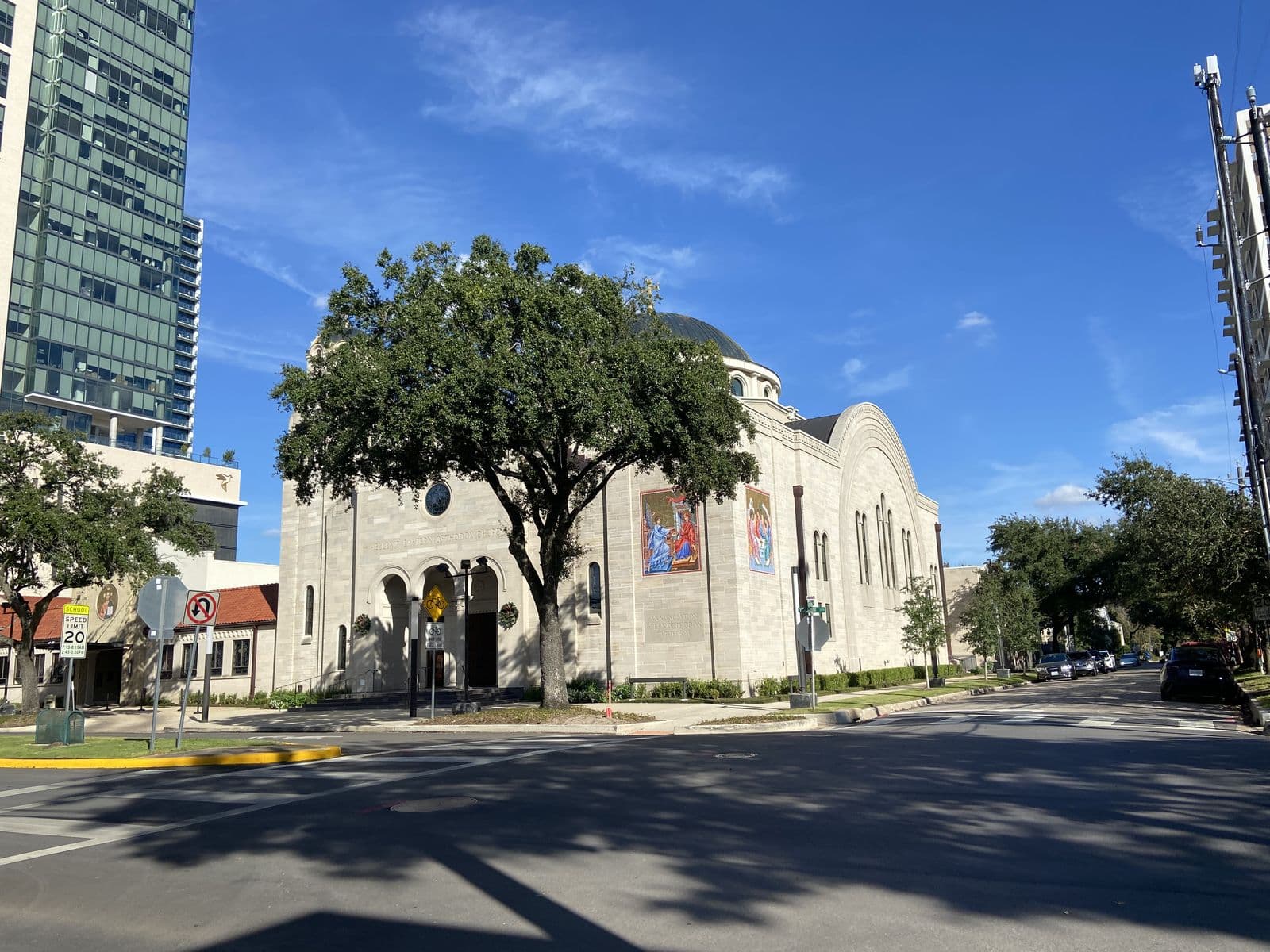
Houston has the most churches and the oldest story. The Greek cathedral of the Annunciation stands in the Museum District, a Byzantine church built between 1950 and 1952 on a lot the parish bought after the war. The Antiochian parish of St George is on Mercer Street, and the Russian Church Abroad has had St Vladimir on Tidwell Road since 1957. Fifty miles south, on the island, is Galveston's Sts Constantine and Helen, the parish where Orthodoxy in Texas began.
Dallas–Fort Worth
Dallas–Fort Worth is the seat of a diocese. St Seraphim Cathedral on Wycliff Avenue is where the Orthodox Church in America's Diocese of the South is governed from, and the Greek parish of Holy Trinity on Hillcrest Road hosts the Greek Food Festival of Dallas, now in its seventy-second year. Across the Metroplex in Fort Worth, St Demetrios has been on the map since 1910. UT Dallas and SMU have Orthodox Christian Fellowship chapters, and so does TCU.
Austin and San Antonio
Austin and San Antonio are an hour and a half apart on I-35 and share the Hill Country between them. Downtown Austin has the Antiochian parish of St Elias on East 11th Street; Transfiguration Greek Orthodox Church is on the west side. San Antonio has St Sophia on North St Mary's Street and the OCA parish of St Anthony the Great just south of downtown. In the hills north of San Antonio, the Holy Archangels Greek Orthodox Monastery at Kendalia, founded in 1996 by Elder Ephraim, follows the Athonite rule and receives pilgrims.
The west and the Valley
The west and the Valley are Orthodox too, only more thinly. The OCA has missions in Alpine, Harlingen and Pharr, the Russian Church Abroad has one in Lubbock, and El Paso sits more than ten hours west of Houston. East of Dallas, the OCA's Nativity of Our Lord Monastery at Kemp, a women's community formed in 2009, is the diocese's other monastic house.
Cathedrals and parishes worth knowing

The cathedral of the Metropolis of Denver, built in 1950 to 1952, and the home of the Original Greek Festival, held in early October; in 2026 for the sixtieth time.
3511 Yoakum BoulevardMuseum District
An Antiochian parish with a visitors' page that walks a newcomer through the service before the first visit.
5311 Mercer StreetHouston
Founded in 1957; services in Church Slavonic and English.
24 East Tidwell RoadHouston
Organized in 1895, the first Orthodox parish in Texas, with the icons and Gospel book sent by Tsar Nicholas II and its first priest buried beneath the altar.
4109 Avenue LGalveston
The seat of the Diocese of the South; all services in English, with confession and liturgy in Spanish and Church Slavonic once a month.
4208 Wycliff AvenueDallas
Host of the Greek Food Festival of Dallas, held in early November, and sponsor of the OCF chapters at UT Dallas and SMU.
13555 Hillcrest RoadDallas
Founded in 1910, the first Greek Orthodox parish in Texas.
2020 NW 21st StreetFort Worth
An Antiochian parish a few blocks from the Capitol.
408 East 11th Streetdowntown
Home of the Austin Greek Festival, held on Memorial Day weekend.
414 St Stephens School Road SouthAustin
Host of the San Antonio Greek FUNstival, held in mid October.
2504 North St Mary's StreetSan Antonio
This is a short list; the full one, every parish of every jurisdiction in Texas, is the directory of the Assembly of Canonical Orthodox Bishops.
Distances that decide everything
A schematic, not a map. Driving times as given in the text.
In Texas the unit of distance is the interstate, and the numbers are honest: Houston to Dallas is about four hours on I-45, Houston to San Antonio about three on I-10, Dallas to Austin about three on I-35, and Austin to San Antonio an hour and a half. El Paso is more than ten hours from Houston and belongs, for practical purposes, to another map. Inside each corner of the triangle the calculation is subtler: Galveston is an hour from central Houston on a good day, Fort Worth and Dallas are two cities that share one airport, and the Hill Country roads between Austin and Kendalia are slower than the map suggests.
Choose a search radius by the interstate you would really drive on a Sunday for a liturgy and a lunch, and then home. In Texas that is one corner of the triangle for almost everyone; a search across the whole state finds more people and makes every first meeting a four-hour drive on I-45 or I-35, which is a fair trade for some and not for others. Say on your profile which you are.
The Orthodox year in Texas
Parish festivals
The Greek festivals are the largest open doors of the year, and in Texas they run from spring to late autumn: Austin on Memorial Day weekend, Houston's Original Greek Festival in early October, San Antonio's FUNstival in mid October, and the Greek Food Festival of Dallas in early November. On the surface a festival is a food fair; underneath it is the parish's reunion, and it is the one weekend of the year when a stranger at the door is the point.
Theophany
On or near 6 January the Great Blessing of the Waters is served in every parish, and where there is water to bless outdoors, the Gulf, a river or a lake, the parish goes to it. People who have not seen each other since Nativity stand together afterwards.
Orthodox Christian Fellowship
Texas A&M has one of the largest OCF chapters in the country and the Church's first campus missionary; UT Dallas, SMU and TCU have chapters too. If you are a student or a recent graduate, this is the network that already exists.
Pilgrimages
Holy Archangels Monastery at Kendalia receives visitors by its own schedule and closes to guests in the first week of Great Lent; the Nativity of Our Lord Monastery at Kemp is the women's community east of Dallas. A weekend at a monastery is where people from different parishes meet with no festival tent between them.
Sunday of Orthodoxy
The first Sunday of Great Lent brings the parishes of each city together for a single Pan-Orthodox Vespers, with the clergy and faithful of every jurisdiction under one roof. The host parish rotates; the diocesan sites say where it is this year.
Diocesan gatherings
Each diocese has its own: diocesan assemblies, youth and young-adult retreats, clergy-laity meetings. They are announced on the diocesan sites linked above, and they are where people from different parishes meet.
Dating across jurisdictions, and with converts
A Greek from the Annunciation Cathedral in Houston and a convert from St Seraphim in Dallas are both Orthodox, and what they need to know first is what that means on a Friday. The cana.love questionnaire was written for exactly that conversation.
Practice, not labels
It asks which church you go to and how often you are actually there, what you do about fasting, and whether you are looking for marriage or for someone to text with. Orthodox members pick from twelve jurisdictions listed one by one, OCA, ROCOR, Greek, Antiochian, Serbian and the rest, and Catechumen is a choice of its own for people still on the way in.
Five languages, Spanish included
The site is fully translated into English, Spanish, Portuguese, German and Russian. In Texas that reaches the Russian-speaking parishes from Houston to McKinney and the Spanish of the Valley and the cities; an optional AI feature translates a message between members who write in different languages.
Checked before it is visible
Every profile and every photo is checked before it becomes visible to anyone, and anything doubtful is looked at by a person. Asking members for money is a permanent removal, with no warning first.
Free, with no paid tiers
There is no subscription and there are no paid tiers: who viewed you and who liked you is visible for free, which on most sites is the paid part. Optional AI extras use credits, 150 of them at registration, and at present there is no way to get more. Sign-in is a one-time link or code to your email, with no password to remember.
What cana.love is and is not
cana.love is not an Orthodox-only platform.
It is open to Christians of other traditions and to people who share the same view of marriage without a confession of their own; every member sets filters for whom they want to see. A Texan who has driven three hours to a parish should hear that before registering, not after. The promise the site does make is that your jurisdiction, your practice and your intention are asked on the form and answered by everyone you meet. The About page tells the rest.
Meeting safely
- Do not send money to anyone you have not met in person; on cana.love the request itself gets the account removed for good.
- First meetings belong in a public place, with someone you trust told where you are, and the conversation stays on the site until you decide to move it.
What is reviewed, what gets reported and how an appeal works are all on the guidelines page.
Common questions
Is cana.love available in Texas?
Yes. It is a web application open to adults anywhere, Texas included, and it works in a browser on a phone or a computer with nothing to install, in English, Spanish, Portuguese, German and Russian.
How far should I search in Texas?
By the drive you would make on a Sunday for a liturgy and lunch: one corner of the triangle for most people, Houston, Dallas–Fort Worth or Austin–San Antonio. Widen to the whole state only if you are ready for I-45 or I-35 before a first meeting.
Which jurisdictions have cathedrals in Texas?
The Greek Archdiocese in Houston and the Orthodox Church in America in Dallas on this page; the Antiochian, Russian and Serbian churches have parishes in Houston, Austin, San Antonio and Galveston.
Are there Orthodox monasteries in Texas?
Two: Holy Archangels at Kendalia in the hills north of San Antonio, founded in 1996 by Elder Ephraim, and the OCA's Nativity of Our Lord at Kemp, east of Dallas, a women's community formed in 2009.
Where is the oldest Orthodox parish in Texas?
Sts Constantine and Helen in Galveston, organized in 1895 with the support of Tsar Nicholas II; the oldest Greek parish is St Demetrios in Fort Worth, founded in 1910.
Where can I find every Orthodox parish in Texas?
In the directory of the Assembly of Canonical Orthodox Bishops, which every jurisdiction feeds, and on the sites of the Greek Metropolis of Denver, the OCA Diocese of the South, the Antiochian Archdiocese, the ROCOR Diocese of Chicago and Mid-America and the Serbian Diocese of New Gracanica and Midwestern America.
Next steps
Create a profile at cana.love, and read the community guidelines before you write to anyone; the About page explains who runs the site and on what terms. Then find your corner of the triangle, find its calendar, and find the person.
Reviewed on September 19, 2026.
Photographs, all Wikimedia Commons: Annunciation Greek Orthodox Cathedral, Houston — WhisperToMe, CC0 · Sts Constantine and Helen Serbian Orthodox Church, Galveston — Драган Цветковић Ниш, CC BY-SA 4.0 · St Seraphim Orthodox Cathedral, Dallas — Michael Barera, CC BY-SA 4.0 · Holy Trinity Greek Orthodox Church, Dallas — Frj, CC BY-SA 4.0 · Saint George Chapel at Annunciation Greek Orthodox Cathedral, Houston — WhisperToMe, CC0