Orthodox Christian dating in Ohio
Orthodox dating in Ohio: Cleveland's Tremont with its thirteen cupolas, Columbus, Cincinnati and Toledo, and how to find a spouse. Free, no subscription.
Create your profileAn illustration, not a data map.
- OCA
- Greek
- Serbian
- Monastery


Short answer
If you are Orthodox and single in Ohio, the Church here comes in two ages. The old one is in the northeast: St Theodosius in Cleveland's Tremont, founded in 1896 and crowned since 1912 with thirteen cupolas, the oldest Romanian Orthodox parish in the United States on Warren Road, the Greek church of the Annunciation a few blocks from St Theodosius, the Serbian cathedral of St Sava in Parma and two Serbian monasteries in the hills south of the city. The new one is everywhere else: parishes in Columbus, Cincinnati and Dayton founded between 1976 and 2000 by missions, university students and an air-force chaplaincy, many of them in English from the first day.
This page leads to cana.love, a free dating site for people who want marriage, whose questionnaire asks which church you attend and how often, what you do about fasting, and which of twelve Orthodox jurisdictions is yours, so that someone from Tremont and someone from the campus parish in Columbus can find each other by practice, not by a label.
Not an Orthodox-only site; the section on what cana.love is and is not says who else is on it.
Orthodox Christians in Ohio
Orthodoxy came to Ohio with the mills of Cleveland. The first church of St Theodosius was built in 1896 on Literary Road; in 1911 the cornerstone of the present cathedral was laid on Starkweather Avenue, to a design by the Cleveland architect Frederick Baird, and Bishop Alexander consecrated it in 1912, built in the shape of a cross under thirteen crosses and cupolas for Christ and the twelve apostles. In 1904 the Romanians of Cleveland founded the parish that is now St Mary Cathedral, which its episcopate calls the oldest Romanian Orthodox parish in the country; the Greeks of Tremont built the Annunciation on West 14th Street; and in Columbus the Greek parish of the Annunciation was chartered by the State of Ohio in 1910.
Since then the largest change has been the converts: adults who came to the faith with no Orthodox family behind them. It has been counted: across twenty parishes in six jurisdictions and fifteen states, the Orthodox Studies Institute found that two thirds of the people received since 2013 were under forty when they came in, that the thirties were the largest single age group, and that 44 percent arrived unmarried.
Orthodox Studies Institute, 2024; national figures, not Ohio's
Ohio was not counted separately, but the person in those figures is the one at coffee hour in Columbus or Cincinnati: an adult who chose the faith, often from a Protestant background, and who has not married yet. St Gregory of Nyssa in Columbus began on the eve of its patron's feast in January 1983, when thirteen people came to a service meant to be a campus mission for Ohio State students and townspeople who wished to worship in English; St Paul the Apostle in Dayton began in 1985 with the Orthodox chaplaincy at Wright-Patterson Air Force Base; Christ the Savior in Cincinnati dates from 1976, and Holy Trinity in Parma from six founding families in 1963. The old parishes keep their Slavonic, Romanian, Greek and Serbian, and the door beside them is open.
Five jurisdictions do most of the work in Ohio, with several others alongside. The Orthodox Church in America's Diocese of the Midwest keeps St Theodosius Cathedral in Cleveland and parishes from Parma and Canton to Columbus, Cincinnati and Dayton, its Romanian Episcopate has its cathedral of St Mary in Cleveland, and its Archdiocese of Pittsburgh reaches across the Ohio River into the steel towns of the east. The Greek Orthodox Archdiocese has the Annunciation Cathedral in Columbus, in the Metropolis of Pittsburgh, the Annunciation in Cleveland and Holy Trinity Cathedral in Toledo. The Serbian Orthodox Diocese of Eastern America has St Sava Cathedral in Parma, parishes in Akron, Columbus, Cincinnati, Lorain and North Canton, and the monasteries of New Marcha at Richfield and St Mark at Sheffield. The American Carpatho-Russian Orthodox Diocese runs its Tri-State deanery from St Clairsville, and the Russian Orthodox Church Outside Russia has an Ohio deanery. Bulgarian, Albanian and Antiochian parishes exist as well, and the Assembly of Canonical Orthodox Bishops keeps the directory that lists them all.
Where the community gathers
Ohio is four Orthodox worlds along I-71 and I-75: Cleveland and the northeast, Columbus, Cincinnati and Dayton, and Toledo.
Cleveland and the northeast
Cleveland and the northeast are the old heart. St Theodosius stands in Tremont with its thirteen cupolas, and the Greek Annunciation is on West 14th Street a few blocks away; St Mary, the Romanian cathedral of 1904, is on Warren Road on the West Side; south of the city, Parma has the Serbian cathedral of St Sava and the OCA parish of Holy Trinity on the same Broadview Road, and Richfield, further down the same road, has the monastery of New Marcha. An hour south, Canton has Holy Assumption, founded in 1958, and Akron has two Serbian parishes; Youngstown and the steel towns along the river have parishes of their own. Everything here is within an hour of Public Square.
Columbus
Columbus is the capital and the campus. The Annunciation Greek Orthodox Cathedral, chartered in 1910, stands on North High Street just north of downtown; St Gregory of Nyssa on Summit Street is the parish that grew out of the Ohio State mission of 1983, in English from the start; St Nicholas the Wonderworker is just south of the campus; and the Serbian parish of St Stephen of Dechani is on the east side. Two hours from Cleveland and an hour and a half from Cincinnati, Columbus is where a person from either end of the state is halfway.
Cincinnati and Dayton
Cincinnati and Dayton are the southwest, an hour apart on I-75. Christ the Savior in Norwood has been Cincinnati's OCA parish since 1976, and the Serbian parish of St George is on Glenview Avenue; St Paul the Apostle in Dayton, founded in 1985 out of the chaplaincy at Wright-Patterson, is the parish of the air-force city. Both look south and west as much as north: Kentucky is across the river.
Toledo
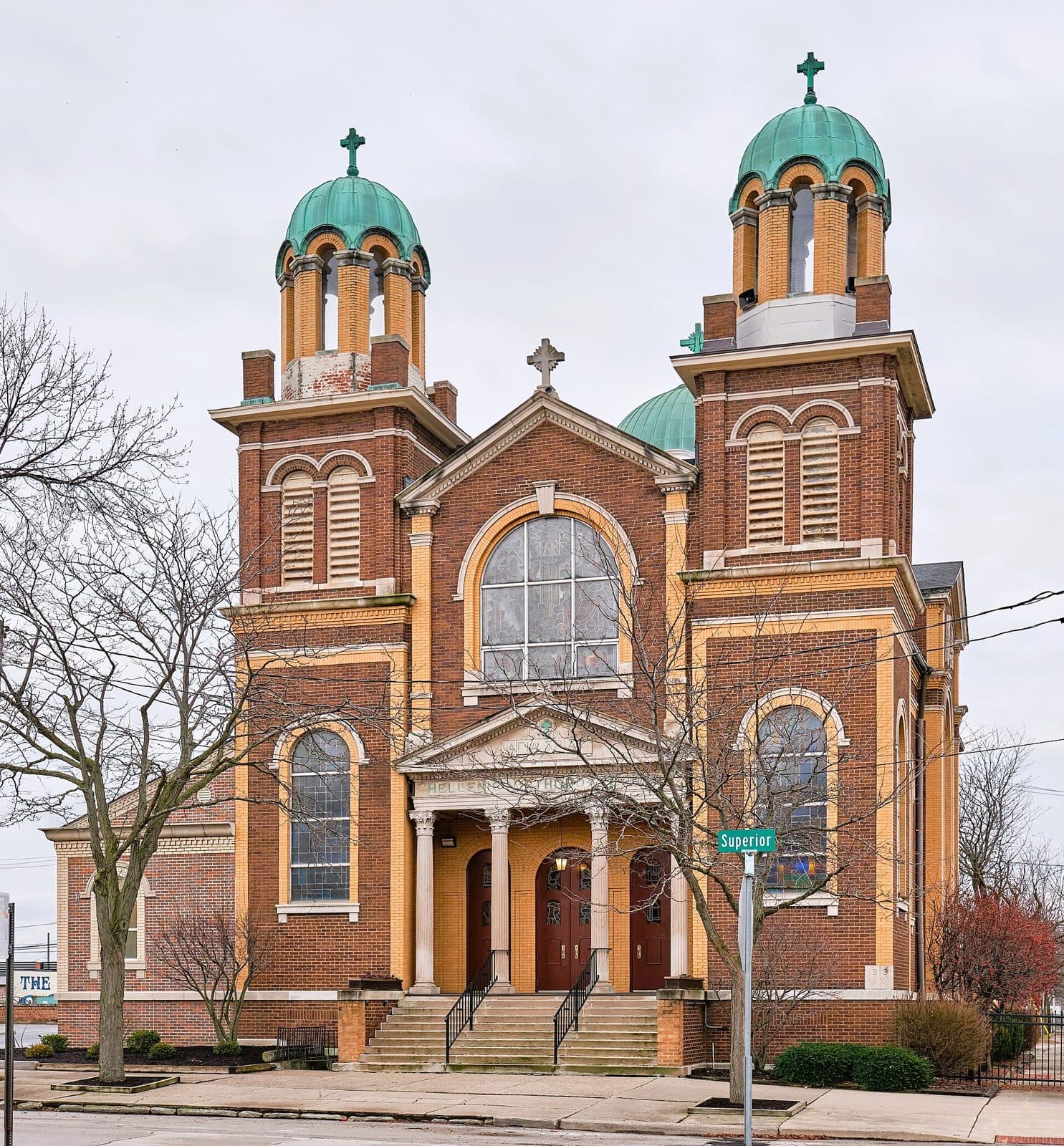
Toledo is the north, two hours from Cleveland along the lake and two and a half from Columbus. Holy Trinity Greek Orthodox Cathedral on Superior Street is the Orthodox landmark of the city, and Michigan and its parishes are half an hour away.
Cathedrals and parishes worth knowing

Founded in 1896; the cathedral of 1912, built in the shape of a cross under thirteen cupolas, was consecrated by Bishop Alexander.
733 Starkweather AvenueTremont
The Greek parish a few blocks from St Theodosius.
2187 West 14th StreetTremont
Established in 1904, which its episcopate calls the oldest Romanian Orthodox parish in the United States, and the seat of its bishop.
3256 Warren RoadCleveland
The cathedral of the Serbian Diocese of Eastern America in Ohio.
6306 Broadview RoadParma
Chartered by the State of Ohio in 1910, in the Metropolis of Pittsburgh; the cathedral just north of downtown.
555 North High StreetColumbus
Founded in 1983 as a campus mission for Ohio State students and townspeople who wished to worship in English.
2219 Summit StreetColumbus
The Serbian parish of Columbus.
1840 North Cassady AvenueColumbus
Founded in 1985 by Orthodox Christians of the Wright-Patterson Air Force Base chaplaincy.
4451 Wagner RoadDayton
Beyond these twelve, the directory of the Assembly of Canonical Orthodox Bishops lists every Orthodox parish in Ohio, with all jurisdictions contributing.
Distances that decide everything
A schematic, not a map. Driving times as given in the text.
Ohio is a state of two-hour drives, and the numbers are honest: Cleveland to Columbus is about two hours on I-71, Columbus to Cincinnati an hour and a half, Cincinnati to Dayton an hour on I-75, Toledo to Cleveland two hours along the lake, two and a half to Columbus down US-23, and three from Dayton straight up I-75. Inside each world the calculation is subtler: Tremont, Parma and Richfield are one half-hour of Broadview Road, Canton and Akron are an hour from Cleveland, and in Columbus the cathedral, the campus parish and the Serbian church are a short drive apart.
Set your search radius by the Sunday you would really spend, liturgy, lunch and the two-hour drive home, not by the state line. For most Ohioans that is one world: the northeast, Columbus, or Cincinnati and Dayton. A statewide search finds more people and turns every first meeting into a day on I-71, which is a fair trade for some and not for others; the profile is where to say which.
The Orthodox year in Ohio
Parish festivals
The Greek parishes of Cleveland, Columbus, Toledo and Cincinnati and the Serbian parishes of the northeast keep their festivals and slavas from spring to autumn, and the parish sites announce the dates. The festival is a food fair on the outside and a parish reunion inside, and it is the one weekend when a new face at the door is expected.
The campus
St Gregory of Nyssa was founded as a campus mission for Ohio State, and St Nicholas the Wonderworker stands just south of the campus; if you are a student or a recent graduate in Columbus, these are the parishes that already expect you.
Pilgrimages
The Serbian monasteries of New Marcha at Richfield and St Mark at Sheffield are within an hour of Cleveland. People from different parishes meet at the monasteries as they never do at a festival.
The feast of St Theodosius
The cathedral in Tremont keeps its patronal feast in May, and a church with thirteen cupolas and a hundred and thirty years of history is worth the drive from any parish of the northeast that day.
Sunday of Orthodoxy
On the first Sunday of Great Lent the parishes of Cleveland, Columbus and Cincinnati each keep a Pan-Orthodox Vespers, the clergy and faithful of every jurisdiction in one church for an evening; the host parish changes yearly and the diocesan sites announce it.
Diocesan gatherings
Every diocese keeps its own assemblies, young-adult retreats and clergy-laity meetings, announced on the sites above; they are where the northeast meets Columbus and Cincinnati.
Dating across jurisdictions, and with converts
Someone from St Theodosius in Tremont and someone from St Gregory of Nyssa by the Ohio State campus are both Orthodox, and the first thing they need to know is what that means during the Nativity fast. The cana.love questionnaire is written to open that conversation.
Practice, not labels
It asks which church you attend and how often you are actually there, what you do about fasting, and whether you want marriage or a friend to write to. Orthodox members choose from twelve jurisdictions listed separately, OCA, ROCOR, Greek, Antiochian, Serbian, Romanian and the others, with Catechumen as a choice in its own right.
Five languages, Russian included
English, Spanish, Portuguese, German and Russian, each fully translated. In Ohio that reaches members who write in Russian and the Spanish the cities speak at home; an optional AI feature translates a message between members writing in different languages.
Checked before it is visible
Every profile and every photo is reviewed before it is visible, and anything doubtful is read by a person. Asking members for money gets a permanent removal with no warning.
Free, with no paid tiers
There is no subscription and there are no paid tiers; seeing who viewed you and who liked you is free, which on most sites is the part behind the paywall. Credits pay for the optional AI extras, 150 of them come with registration, and there is currently no way to top that number up. You sign in with a one-time link or code to your email, and there is no password.
What cana.love is and is not
cana.love is not an Orthodox-only platform.
Christians of other traditions and people who share the same values about marriage without a confession of their own are here too, and every member sets filters for whom they see. In a state where half the parishes were founded by converts, we would rather say so before you register. What the site promises is that your jurisdiction, your practice and your intention are questions on the form, answered by everyone you meet; the About page gives the full account.
Meeting safely
- Never send money to someone you have not met in person; on cana.love asking for it is a permanent removal.
- Meet in a public place, tell someone where you are going, and keep the conversation on the site until you are comfortable moving it.
How profiles are reviewed, how a report is handled and how to appeal are on the guidelines page.
Common questions
Is cana.love available in Ohio?
Yes. It is a web application open to adults anywhere, Ohio included, in English, Spanish, Portuguese, German and Russian; it runs in a browser on a phone or a computer, and there is nothing to install.
How far should I search in Ohio?
By the Sunday drive you would actually make for a liturgy and lunch: one world for most people, the northeast, Columbus, or Cincinnati and Dayton. Widen to the whole state only if two hours on I-71 before a first meeting does not put you off.
Which jurisdictions have cathedrals in Ohio?
On this page: the Orthodox Church in America in Cleveland, twice, counting the Romanian cathedral of St Mary; the Serbian Church in Parma; and the Greek Archdiocese in Columbus and Toledo.
Are there Orthodox monasteries in Ohio?
Two Serbian monasteries south of Cleveland, New Marcha at Richfield and St Mark at Sheffield; the section on the Orthodox year describes the pilgrimages to them.
Where is the oldest Orthodox parish in Ohio?
St Theodosius in Cleveland, whose first church was built in 1896 and whose cathedral of thirteen cupolas dates from 1912; St Mary in Cleveland, founded in 1904, is the oldest Romanian Orthodox parish in the whole country.
Where can I find every Orthodox parish in Ohio?
In the directory of the Assembly of Canonical Orthodox Bishops, kept with every jurisdiction, and on the sites of the OCA Diocese of the Midwest, the Greek Metropolis of Pittsburgh, the Serbian Diocese of Eastern America and the American Carpatho-Russian Orthodox Diocese.
Next steps
Create a profile at cana.love, read the community guidelines before your first message, and the About page if you want to know who runs the site and how. Then find your world of the state, find its calendar, and find the person.
Reviewed on September 19, 2026.
Photographs, all Wikimedia Commons: The thirteen cupolas of St Theodosius Orthodox Cathedral in Tremont, Cleveland — Nheyob, CC BY-SA 4.0 · Annunciation Greek Orthodox Church in Tremont, Cleveland — Warren LeMay, CC0 · Annunciation Greek Orthodox Cathedral on North High Street, Columbus — Ɱ (Wikimedia Commons), CC BY-SA 4.0 · Holy Trinity Greek Orthodox Cathedral, Toledo — Chris Rycroft, CC BY 2.0 · Inside St Theodosius Orthodox Cathedral, Cleveland — Ronrodjr, CC0